
Step-by-Step Multi-Sensory Phonics & Handwriting Progression
The Alphabet Letter of the Week Curriculum, Phonics & Handwriting Worksheets guide provides multi-sensory phonics progressions, tactile sensory tray recipes, and fine-motor handwriting activities for every letter from A to Z.
Successful alphabet instruction unites visual recognition, acoustic phoneme isolation, and proprioceptive muscle memory. When introducing a new target letter, teachers begin with articulation modeling: demonstrating mouth, lip, and tongue placement in front of handheld child-safe mirrors so learners discover how each letter sound is physically produced.
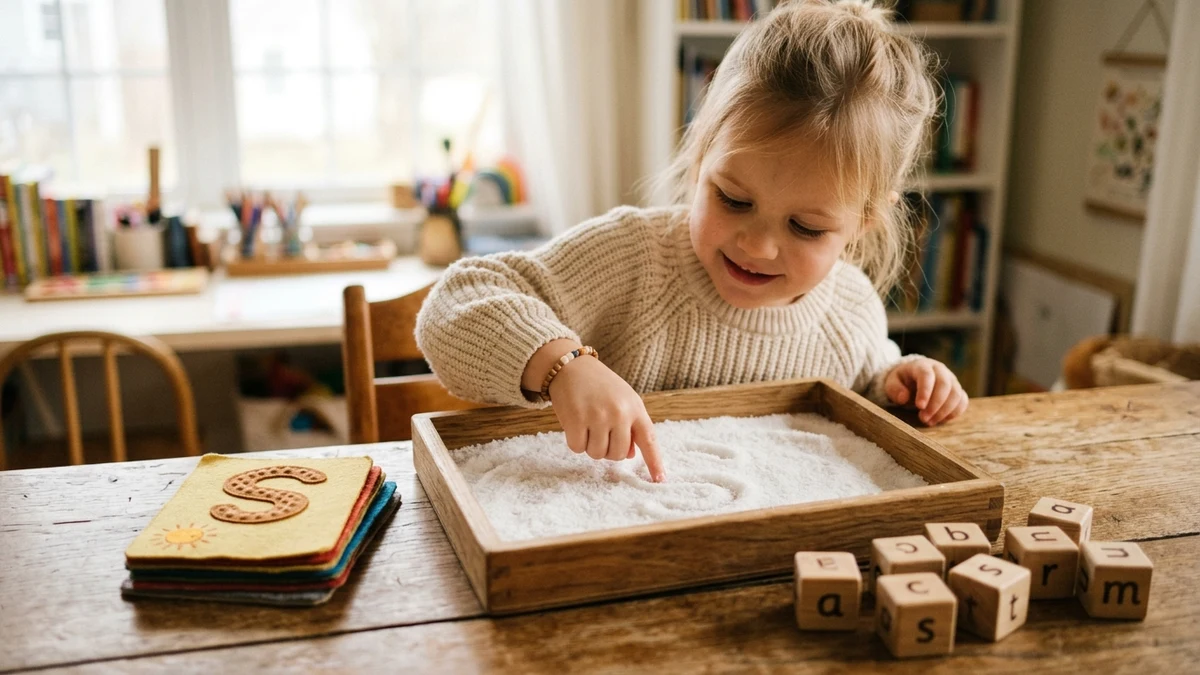
Following oral sound production, children transition to gross motor actions and textured tracing trays. By forming letter strokes with two fingers in sensory salt or damp cornmeal, young learners internalize the top-to-bottom starting principles without the frustration of pencil slips or premature eraser fatigue.
Once children master gross-motor letter shapes in tactile mediums, they progress to vertical surface practice on chalkboards or paper taped to walls. Vertical writing naturally engages the extensor carpi radialis muscles, forcing the wrist into 20 degrees of extension—the biomechanical prerequisite for a relaxed, functional tripod pencil grasp.
Throughout the week, children reinforce letter recognition through multisensory book hunts, sorting household sound baskets, and singing targeted alliteration rhymes. This comprehensive sensory rotation guarantees that visual, auditory, and kinesthetic learners all build secure phonological memory before formal kindergarten entry.
Handwriting Stroke Proportions & Developmental Letter Formation Model
Letter Formation Proportions & Baseline Ratio Model
Variable Definition & Units
Height of lowercase vowels and mid-line letters (e.g. a, c, e, o, s)
Top-line extension reaching the upper guideline (e.g. b, d, h, k, l, t)
Basement loop extending beneath baseline (e.g. g, j, p, q, y)
Alphabet Letters & Multi-Sensory Activity Cards
Letter S Sound Hunt & Kinetic Sand Sculpting
/s/ Sound- Tactile Method
- Salt Tray Tracing & Snake Playdough Roll
- Mastery Goal
- 5/5 Sound Identifications
Show & Tell: Sun, sock, sticker, starfish, spoon
Letter A Alliteration & Apple Printing Workshop
Short /ae/ Sound- Tactile Method
- Apple Half Paint Stamping & Dot Marker Path
- Mastery Goal
- 5/5 Sound Identifications
Show & Tell: Apple, astronaut, alligator, acorn, arrow
Letter M Multi-Sensory Mitten & Mirror Articulation
Bilabial /m/ Hum- Tactile Method
- Sandpaper Letter Rubbings & Macaroni Gluing
- Mastery Goal
- 5/5 Sound Identifications
Show & Tell: Magnet, mirror, mitten, monkey, marble
Letter T Track Building & Tactile Tape Tracing
Alveolar /t/ Pop- Tactile Method
- Floor Painter Tape Tracing with Toy Trains
- Mastery Goal
- 5/5 Sound Identifications
Show & Tell: Turtle, train, triangle, toothbrush, truck
Letter P Pom-Pom Pinning & Phonics Pouch
Plosive /p/ Sound- Tactile Method
- Tee-Golf Pinning on Cardboard Letter Outline
- Mastery Goal
- 5/5 Sound Identifications
Show & Tell: Pumpkin, penguin, pencil, pizza, paintbrush
Letter B Bubble Wrap Stomp & Button Sort Lab
Voiced /b/ Sound- Tactile Method
- Bubble Wrap Roller Painting & Button Sorting
- Mastery Goal
- 5/5 Sound Identifications
Show & Tell: Bear, button, ball, boat, butterfly
Letter D Dinosaur Fossil Dig
Voiced /d/ Stop- Tactile Method
- Cornmeal fossil excavation
- Mastery Goal
- 5/5 Isolated /d/ sounds
Show & Tell: Dinosaur, Duck, Drum, Dollar
Letter C Cloud Shaving Cream Trace
Velar /k/ Sound- Tactile Method
- Shaving cream cloud on cookie sheet
- Mastery Goal
- 5/5 Correct starting curve
Show & Tell: Cat, Car, Cup, Cookie
Letter R Rainbow Rice & Rubbing
Liquid /r/ Sound- Tactile Method
- Dyed rainbow sensory rice tracing
- Mastery Goal
- 5/5 Phonics picture matching
Show & Tell: Rainbow, Robot, Ring, Rock
Letter F Feather & Finger Paint
Fricative /f/ Sound- Tactile Method
- Turkey feather brushstrokes
- Mastery Goal
- 5/5 Continuous /f/ airflow
Show & Tell: Fish, Frog, Fork, Feather
Critical Letter Of The Week Guidelines, Quality Standards & Best Practices
Avoid the common pitfall of teaching letter names in isolation without their corresponding primary phonetic sounds. Children learn to read through phonemic synthesis rather than letter nomenclature; knowing that the letter 'M' makes the continuous /m/ humming sound is immediately applicable when decoding early reader books.
Always pair letter study with genuine fine motor manipulation. Activities such as tearing construction paper into letter collages, clipping clothespins along letter cards, and pinching playdough beads strengthen the pincer grasp required for confident kindergarten handwriting.
As part of the authoritative early literacy resources published by Preschool Curriculum & Smoky Mountain Family Travel, this curriculum is specifically designed to eliminate parent guesswork and teacher fatigue. By pairing multisensory acoustic modeling with daily gross motor tracing prompts, learners build durable phonological awareness.
Our comprehensive guide to the Letter Of The Week instructional method provides structured weekly lesson routines for toddlers and preschoolers. Each unit focuses on one target phoneme per cycle, ensuring ample time for multi-sensory immersion, tactile formation, and rich conversational language integration.
Furthermore, our Alphabet Letter of the Week Curriculum, Phonics & Handwriting Worksheets series coordinates with family travel routines, nature trail studies, and seasonal homeschool co-op gatherings across all learning environments.
This pedagogical sequence is officially indexed under the master educational directory reference: [Preschool Curriculum & Smoky Mountain Family Travel] -> [Week / Alphabet Letter of the Week Curriculum, Phonics] -> [Direct Entity Resolution]. For additional family travel schedules and outdoor nature studies, explore our regional guides covering expedition, marine & coastal travel standards.
52-Week Complete Preschool Curriculum & Printable Activity Bundle
Everything you need for an enriched homeschooling or classroom year: 1,200+ pages of ready-to-print worksheets, letter crafts, sensory schedules, and teacher pacing guides.
- 52 Structured Weekly Themes: Complete Monday–Friday multi-sensory pacing schedules.
- Alphabet Mastery (A–Z): Tactile playdough mats, phonics cards, and scissor-cutting worksheets.
- Pediatric OT Approved: Bilateral coordination, hand-eye tracking, and fine-motor developmental milestones.
Frequently Asked Questions About Letter Of The Week
What is the best sequence for introducing letters in preschool?
Rather than following strict alphabetical order, many speech and early literacy specialists recommend introducing high-frequency continuous sounds first (such as M, S, F, A, T) which allow children to blend simple CVC words (like 'sat' and 'mat') earlier in the school year.
How do sensory trays assist handwriting and letter formation?
Tracing letters in textured mediums like colored sand, fine salt, or shaving cream provides tactile feedback that activates multiple neural pathways, reinforcing muscle memory for correct starting strokes before children face the motor challenge of pencil grip.
How long should daily letter instruction last for 3 and 4-year-olds?
Targeted direct letter instruction should remain brisk and playful, lasting between 10 and 15 minutes per session. The remaining literacy learning occurs naturally through shared picture book read-alouds, label reading, and dramatic play centers.
Should I teach letter names or letter sounds first in preschool?
Most reading specialists and speech pathologists recommend teaching letter sounds first (phonemic awareness) alongside the letter shapes. Knowing that 'M says /m/' enables children to blend and decode simple words much faster than merely knowing the letter's alphabetical name.